S U H A S O F T

Loading

img

Enterprise Resource Planning

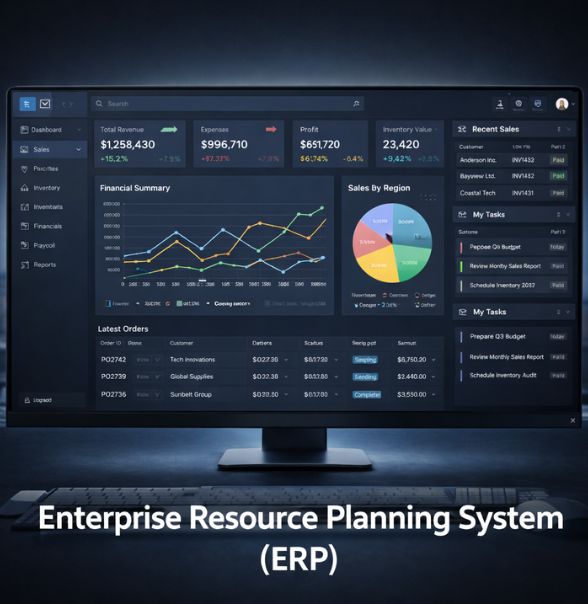
ERP (Enterprise Resource Planning) refers to an integrated software system designed to unify and streamline all major functions of an organization—its entire business operations—such as Supply Chain, Sales, Purchase, Warehouse/Stock Management, HRMS, PMS (Project/Process Management System), Services, Finance, and Operations—into a single centralized platform. It enables companies to optimize resources, enhance efficiency, ensure data accuracy, and support strategic decision-making across all departments.

Objectives
  • Unify Business Processes: Integrate all departments into a single system to eliminate silos and ensure smooth information flow.
  • Enhance Operational Efficiency: Automate repetitive tasks, reduce manual errors, and accelerate workflows.
  • Real-Time Data Visibility: Provide accurate, real-time insights for faster decision-making.
  • Optimize Resource Utilization: Ensure optimal use of manpower, inventory, finances, and ../assets.
  • Support Scalability: Enable organizations to grow without increasing operational complexity.
  • Improve Customer & Vendor Experience: Ensure faster response times, better service delivery, and transparent communication.
Key Modules
  • Supply Chain Management (SCM): Inventory control, logistics, order fulfillment, demand forecasting.
  • Sales Management: Lead tracking, quotations, sales orders, invoicing, customer lifecycle management.
  • Purchase Management: Vendor management, purchase orders, approvals, procurement analytics.
  • Finance & Accounting: Billing, general ledger, accounts receivable/payable, budgeting, compliance.
  • HRMS (Human Resource Management): Recruitment, payroll, attendance, leave, policies.
  • PMS (Performance Management System): Goal setting, KPIs, appraisals, skill matrices.
  • Service Management: Service tickets, AMC management, field support scheduling.
  • Project Management: Tasks, timelines, costing, resource allocation, progress monitoring.
  • Compliance & Reporting:Statutory compliance, business intelligence reports, audit trails.
Workflow
  • Data Input & Integration: Departments enter or import data (sales orders, purchase requests, HR records, inventory updates).
  • Process Automation: The ERP automates approvals, alerts, workflows, and task assignments.
  • Cross-Department Sync: Data flows seamlessly between modules—for example:
    • ★ A sales order triggers inventory checks → purchase requests → production planning → invoicing.
  • Real-Time Monitoring: Dashboards display KPIs, financials, resources, and operational status.
  • Execution & Control: Teams execute daily operations—procurement, sales processing, HR activities.
  • Reporting & Analytics:The system generates insights for decision-makers (revenue, performance, trends).
  • Continuous Optimization: Based on analytics, organizations refine processes for better efficiency.
Key Features
  • Centralized Data Management across all departments.
  • Role-Based Dashboards for managers, employees, and executives.
  • Automated Workflows & Approval Processes.
  • Real-Time Reporting and Analytics with KPIs.
  • Multi-Company, Multi-Branch & Multi-Currency Support.
  • Secure Cloud Deployment Models.
  • Mobile Access & Self-Service Portals.
  • Localization for India & Southeast Asia (SGT) including tax, compliance, and statutory requirements.
  • Integration Capability (API support for CRM, payment gateways, third-party apps).
  • Scalable Architecture suitable for small, medium, and large enterprises.
Benefits
  • Improved Productivity through automation and streamlined workflows.
  • Reduced Operational Costs by minimizing duplication, manual effort, and inefficiencies.
  • Faster Decision-Making with accurate, real-time business insights.
  • Better Compliance Management with built-in statutory and audit-ready records.
  • Enhanced Collaboration within and across departments.
  • Improved Customer Satisfaction with timely delivery and faster service.
  • Higher Profitability through optimized processes and resource utilization.
  • Future-Ready Scalability as the business grows.