S U H A S O F T

Loading

img

Hospital Management System

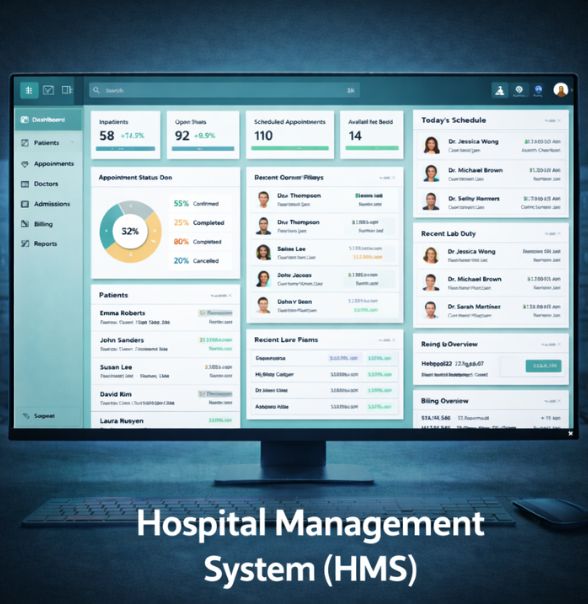
A hospital is a world of its own. Patients flow in with urgent needs, doctors move across departments, machines hum with purpose, and administrators try to keep every detail aligned. A Hospital Management System (HMS) acts as the brain of this world. It connects patient care, staff activity, medical records, billing, pharmacy, laboratory, and administration into one organized ecosystem.

Objectives
  • Streamlined Operations: Unify all hospital processes so that patient care, administration, and finance run smoothly without gaps or confusion.
  • Centralized Medical Records: Maintain accurate, digital patient records that move with the patient across departments.
  • Financial Transparency: Automate billing, insurance claims, pharmacy charges, doctor fees, and departmental costs.
  • Improved Patient Care: Reduce waiting times, ensure better communication among staff, and keep treatment plans consistent.
  • Better Resource Utilization: Optimize beds, equipment, appointments, staff schedules, and inventory.
  • Regulatory & Compliance Support: Provide accurate reporting for government bodies, insurance partners, and auditors..
Key Modules
  • Patient Registration & Appointment Scheduling: Handles outpatient and inpatient registrations, appointment bookings, token management, and patient demographic details.
  • Electronic Medical Records (EMR): Stores patient history, diagnoses, lab reports, radiology images, prescriptions, and treatment progress.
  • Billing & Finance Module:Manages OP billing, IP billing, package rates, insurance billing, advance payments, refunds, and due tracking.
  • Inpatient Management (IPD): Covers bed allocation, ward transfers, nursing notes, treatment orders, diet charts, and discharge summaries.
  • Outpatient Management (OPD): Tracks doctor consultations, prescriptions, lab requests, and follow-ups.
  • Pharmacy Management: Manages drug inventory, dispensing, re-order levels, batch tracking, and billing integration.
  • Laboratory Information System (LIS):Handles lab test orders, sample collection, test processing, result entry, and report generation.
  • Radiology Information System (RIS): Manages imaging requests, scheduling, image tracking, and report creation for X-ray, CT, MRI, ultrasound, etc.
  • Doctor & Staff Management: Keeps data on schedules, availability, roles, payroll elements, and workload distribution.
  • Insurance & TPA Module: Processes insurance claims, pre-authorizations, claim submissions, and outstanding tracking.
  • Inventory & Asset Management: Tracks medical equipment, consumables, purchase orders, vendor details, and maintenance cycles.
  • Administrative & MIS Reporting:Provides dashboards and analytical reports on revenue, patient volume, bed occupancy, departmental performance, and compliance metrics.
Workflow
  • Patient Arrival: The patient visits the hospital and is registered with essential details, or books an appointment ahead of time.
  • Consultation:The patient is assigned to a doctor. Medical history, past reports, and complaints are recorded digitally.
  • Investigations & Treatment: Doctors order lab tests, scans, or other procedures. The orders reach respective departments instantly through the system.
  • Billing Integration: All investigations, procedures, consultations, pharmacy charges, and room charges flow into a unified bill.
  • Admission: The patient receives a bed in the ward or ICU. Nurses update vitals, doctors update treatment plans, and medication orders go to pharmacy.
  • Report Generation: Lab and radiology departments complete tests and upload digital reports to EMR.
  • Discharge Process: Doctors finalize discharge summary, pharmacy completes medication list, and billing finalizes the complete bill.
  • Follow-up: Patients receive scheduled review dates, reminders, and access to their reports.
  • Administration & Reporting: Management uses dashboards for:
    • ★ income
    • ★ expenses
    • ★ staff usage
    • ★ bed occupancy
    • ★ audit reports
    • ★ insurance settlements
Key Features
  • Fully integrated EMR for seamless patient care
  • Real-time appointment and queue management
  • Automated billing with OP, IP, insurance, and package options
  • Pharmacy and lab systems fully connected to the billing module
  • Digital radiology reporting and image attachment
  • Bed management with live occupancy status
  • Role-based access and secure data handling
  • Multi-department and multi-branch support
  • Comprehensive compliance-ready government and audit reports
  • Inventory tracking with alerts for low stock and expiries
Benefits
  • Better Patient Experience: Shorter wait times, faster reports, and clear communication across departments.
  • Improved Medical Accuracy: Doctors and nurses get complete access to patient records, reducing mistakes.
  • Higher Operational Efficiency: Automation removes manual paperwork, duplicate entries, and delays.
  • Stronger Financial Management: Every charge is tracked, every bill is transparent, and revenue leakages are reduced.
  • Resource Optimization:Smart dashboards help manage beds, staff availability, and equipment usage.
  • Easy Compliance: All statutory, insurance, and audit reports are generated instantly and accurately.
  • Scalability: The system grows with the hospital, supporting new departments, machines, and branches.